
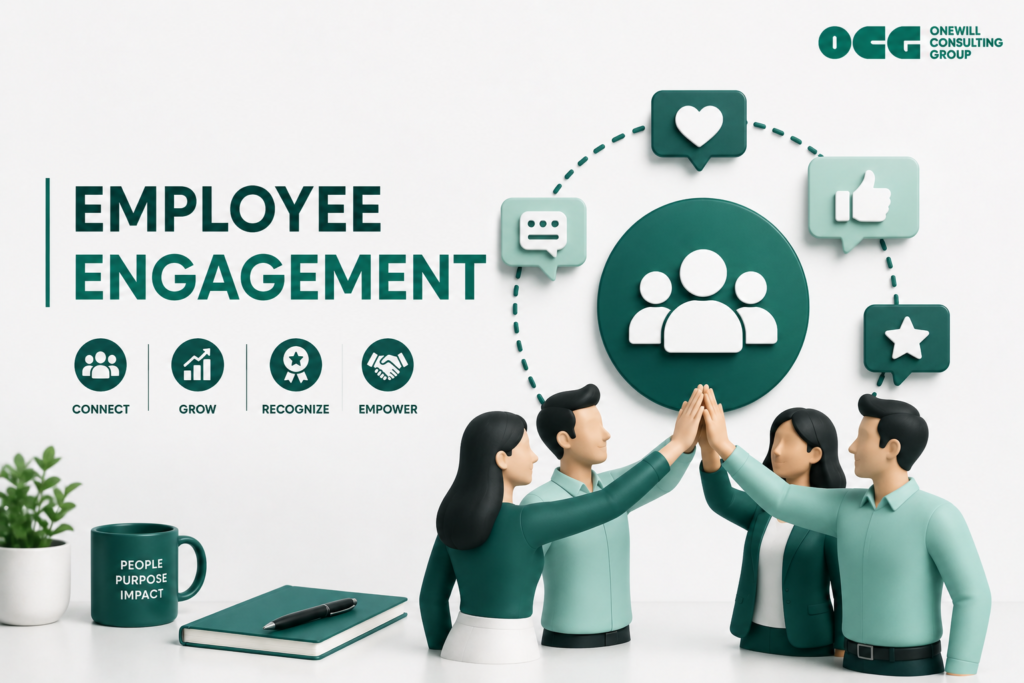
What is Employee Engagement and How Does It Impact Your Business Revenue
Disengaged employees are costing your SME money every single day. Here is what employee engagement really means – and how to fix it fast.
Human Resources | 7 Min Read | By OneWill Consulting Group
Employee Engagement – What It Really Means and Why It Directly Affects Your SME’s Revenue
You have employees who show up every day. They complete their tasks. They attend meetings. They do not cause problems. But they are not really there. They are going through the motions. This is called disengagement – and it is one of the most expensive, invisible problems in Indian SMEs today. The cost is not just productivity. It shows up directly in your revenue, your customer experience, and your growth rate.
What You Will Learn:
-
- What employee engagement actually means- beyond team outings and birthday cakes
-
- The direct link between employee engagement and business revenue
-
- The three types of employees every SME has right now
-
- Practical steps to improve engagement without a large HR budget
What Employee Engagement Really Means
Employee engagement is not about happiness. It is not about perks, office parties, or a casual Friday dress code.
Employee engagement is the degree to which your employees are emotionally invested in the success of your business. An engaged employee does not just do their job. They care about doing it well. They take initiative. They solve problems without being asked. They treat your business as if it were their own.
An disengaged employee does the minimum required to keep their job. A actively disengaged employee does worse – they complain, they undermine, and they influence others around them negatively.
The difference between these two types of employees is not talent. It is how they feel about the work, the team, and the leadership around them. And that is something you as a business owner can directly influence.
The Three Types of Employees in Your SME Right Now
Global research by Gallup – and experience across Indian businesses – consistently shows that in any organisation, employees fall into three categories.
Engaged employees – approximately 30%. These are your stars. They are emotionally committed. They go beyond their job description. They drive most of your business outcomes. They are the people you cannot afford to lose.
Not engaged employees – approximately 50%. These are your sleepwalkers. They are present but not invested. They do what is asked and nothing more. They are waiting to feel inspired – or waiting for a better offer.
Actively disengaged employees – approximately 20%. These are your silent destroyers. They are unhappy and they make sure others know it. They drain team energy, increase conflict, and accelerate attrition among your good people.
Look at your team right now. These three groups exist in your business today. The question is what you are doing about it.
The Direct Link Between Employee Engagement and Revenue
This is not soft HR theory. The numbers are clear and the logic is simple.
Engaged employees are more productive: A sales executive who genuinely cares about outcomes will make more calls, build better relationships, and close more deals than one who is just filling their hours.
Engaged employees deliver better customer experiences: In Indian SMEs, most customer touchpoints are human – a sales call, a delivery interaction, a service visit. When your employee is disengaged, your customer feels it. When your employee is invested, your customer experiences that too. Customer retention follows directly.
Engaged employees stay longer: Every time a good employee leaves, you spend ₹3–5 lakh on recruitment, onboarding, and lost productivity for a mid-level role. High engagement reduces attrition. Lower attrition directly protects your bottom line.
Engaged employees innovate: They suggest process improvements. They identify problems before they become crises. They bring ideas that save costs and create value. Disengaged employees never do this.
A business with 70% engaged employees will consistently outperform a competitor with 30% engagement – regardless of product quality or market conditions.
Why Employee Engagement is Low in Most Indian SMEs
Before you can fix engagement, you need to understand why it breaks down. In our experience with Indian SMEs, the causes are consistent.
Lack of clarity. Employees do not know what is expected of them. No clear KRAs. No defined goals. No feedback on how they are doing. Confusion kills engagement faster than any other factor.
Feeling invisible. In many Indian SMEs, employees only hear from leadership when something goes wrong. There is no regular recognition, no acknowledgement of good work, no sense that their contribution is seen or valued.
No growth path. Young professionals in India – especially in Tier 2 cities like Ahmedabad, Indore, and Coimbatore – are ambitious. If they cannot see a future in your organisation, they will find one elsewhere. A business with no visible career progression will always struggle with engagement.
Poor managerbehaviour. People do not leave companies. They leave managers. A manager who micromanages, dismisses ideas, or plays favourites destroys engagement within their team – regardless of what the organisation does at a higher level.
Disconnect from purpose. Employees who understand why the business exists and how their role contributes to that purpose are significantly more engaged. Most SMEs never have this conversation with their teams.
5 Practical Ways to Improve Employee Engagement in Your SME 
You do not need a large HR budget to improve engagement. You need intentionality and consistency.
1. Start with clarity. Define KRAs and KPIs for every role. Make sure every employee knows exactly what they are responsible for and how their success is measured. Clarity is the foundation of engagement.
2. Create a feedback rhythm. Hold monthly one-on-ones between managers and their direct reports. Not performance reviews – conversations. Ask: What is going well? What is frustrating you? What do you need from me? These conversations cost nothing and build enormous trust.
3. Recognise publicly, correct privately. Indian employees respond powerfully to public recognition. A simple acknowledgement in a team meeting – “Rahul closed our biggest account this month and I want the whole team to know” – costs nothing and creates disproportionate goodwill. Never publicly criticise. Always correct in private.
4. Build visible career paths. For every role in your organisation, define what the next level looks like. What skills does an executive need to become a manager? What does a manager need to do to become a department head? When employees can see a future, they invest in the present.
5. Involve employees in decisions that affect them. You do not need to consult your team on every business decision. But on things that directly affect their work – process changes, policy updates, new tools – ask for input before you finalise. Involvement creates ownership.
How to Measure Employee Engagement in Your SME
You cannot improve what you do not measure. Here are three practical ways to track engagement without an expensive survey tool.
Attrition rate. Track how many people leave every quarter. High attrition is the clearest signal of low engagement. Industry benchmark for Indian SMEs is 15–20% annually. Above that, you have an engagement problem.
Absenteeism rate. Disengaged employees take more unplanned leaves. Track patterns. A team with consistently high unplanned absence has an engagement issue.
Pulse surveys. A five-question anonymous survey sent to your team every quarter takes 10 minutes to design on Google Forms. Ask about clarity, recognition, growth, manager support, and overall satisfaction. The data will tell you exactly where to focus.
OCG EXPERT INSIGHT: In our consulting work with Indian SMEs, we consistently find that engagement problems are leadership problems in disguise. When founders and senior managers are visible, communicative, and genuinely interested in their people, engagement follows naturally. When leadership is distant, transactional, and only present during problems, disengagement spreads like a slow infection. The most powerful engagement tool in any SME is a leader who pays attention.
REAL EXAMPLE FROM OCG: When OneWill Consulting Group engaged with Platina Stones and Ceramics as part of their business transformation journey, employee engagement was identified as a critical lever for growth. Teams were working hard but without alignment, clarity, or a sense of shared purpose. As part of the broader restructuring and strategy work, engagement initiatives were embedded into the business system – not as a standalone HR programme but as a core part of how the business operated. The result was a more motivated, aligned team that contributed directly to the 140% business growth outcome.
Conclusion – Engagement is a Revenue Strategy, Not an HR Initiative
Employee engagement is not a feel-good programme. It is a direct driver of your business revenue, customer satisfaction, and growth rate. The SMEs that scale fastest are not the ones with the best products or the lowest costs. They are the ones where people genuinely want to come to work and give their best. Start with clarity. Add recognition. Build growth paths. Your engagement – and your revenue – will follow.