
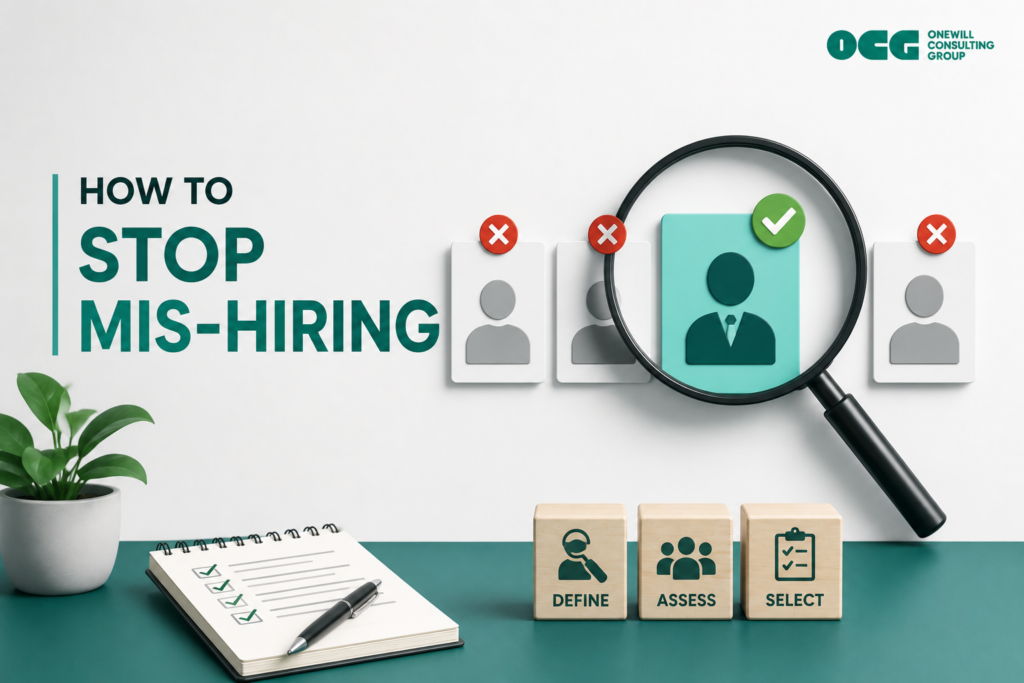
How to Stop Mis-Hiring – A Practical Recruitment Guide for SME Owners
A single bad hire can cost your SME 6 months of salary and months of lost momentum. Here is how to hire right – every time.
Human Resources | 7 Min Read | By OneWill Consulting Group
How to Stop Mis-Hiring – The Practical Recruitment Guide Every Indian SME Owner Needs
You hired someone who looked perfect on paper. Great resume. Confident in the interview. Strong references. Three months later, they are underperforming, disrupting your team, and you are back to square one. Sound familiar? Mis-hiring is the single most expensive mistake a growing SME makes. And in most cases, it is entirely preventable.
What You Will Learn:
- Why mis-hiring happens and what itactually costs your business
- The five most common recruitment mistakes Indian SME owners make
- A practical, step-by-step hiring process you can implement immediately
- How to evaluate candidates beyond their resume and interview performance
What Mis-Hiring Actually Costs Your Indian SME
Most founders underestimate the true cost of a bad hire. They think of it as one month’s salary wasted. The real cost is much higher.
Consider a sales manager hired at ₹8 lakh per year. If they fail within six months, your direct cost includes six months of salary, recruitment fees, onboarding time, and training investment. That is easily ₹6–8 lakh in direct costs.
Then add the indirect costs. Lost sales during the ramp-up period. Team morale damage. Your own time spent managing, correcting, and eventually exiting the person. The total cost of one mis-hire at mid-management level can exceed ₹15–20 lakh when calculated honestly.
And this happens repeatedly in SMEs that do not have a structured hiring process. Fix the process. Stop paying this invisible tax.
Why Mis-Hiring Happens – The Root Causes
Mis-hiring is rarely about bad luck. It almost always traces back to one of these five root causes.
Root Cause 1 – Hiring in a hurry. A position opens. The business feels the pressure immediately. You rush through interviews and hire the best available candidate – not the right candidate. Urgency is the enemy of good hiring.
Root Cause 2 – No clear job definition. You know you need “someone for sales” or “an accounts person.” But you have not defined exactly what success looks like in that role. Without a clear job definition, you cannot evaluate candidates objectively.
Root Cause 3 -Hiring on personality alone. Indian interview culture tends to favour confident, well-spoken candidates. But likability is not competence. Many mis-hires are charming people who cannot actually do the job.
Root Cause 4 – Skipping reference checks. Reference checks are treated as a formality in most Indian SMEs. They are called after the decision is made, not as part of making the decision. This is a missed opportunity to verify your instincts.
Root Cause 5 – No cultural fit assessment. Skills can be trained. Attitude cannot. A technically strong candidate who does not align with your business values will cause more damage than a slightly less skilled candidate who does.
Step 1 – Define the Role Before You Post the Job
Before you write a single job post, answer these four questions in writing.
What are the three most important outcomes this person must deliver in their first 90 days?
What skills, experience, and behaviours are absolutely non-negotiable for this role?
What does this person’s typical day look like? What problems will they solve daily?
Who will this person work with, report to, and manage? What relationships matter most in this role?
This exercise takes 30 minutes. It saves weeks of wasted interviews. Share this document with everyone involved in the hiring decision before the process begins.
Step 2 – Write a Job Post That Attracts the Right People
Most SME job posts are generic. “Looking for a dynamic, go-getter sales professional with 3–5 years experience.” This attracts everyone and filters no one.
A strong job post does three things. It describes the real work clearly. It sets honest expectations about the role and the company. And it gives the right candidate a reason to apply – and the wrong candidate a reason not to.
Mention your company size, culture, and growth stage. Mention the challenges the role involves. Be honest. The right candidate will be attracted by honesty. The wrong candidate will be filtered out by it.
Post on Naukri, LinkedIn, and relevant WhatsApp industry groups for your sector. For senior roles, consider a referral bonus for your existing team. Your best employees usually know other good people.
Step 3 – Build a Structured Interview Process
Unstructured interviews are the biggest source of bias in hiring. When each interviewer asks different questions, you cannot compare candidates fairly.
Build a simple three-stage process.
Stage 1 – Screening call (20 minutes). Verify basic facts. Check communication skills. Confirm salary expectations and notice period. This eliminates mismatches before anyone invests real time.
Stage 2 – Competency interview (45–60 minutes). Ask structured, behavioural questions. Use the STAR format – Situation, Task, Action, Result. Ask every candidate the same core questions. This makes comparison objective.
Good questions for this stage: “Tell me about a time you failed to meet a target. What did you do?” “Describe the most difficult colleague you have worked with. How did you manage that relationship?” “What does a great week at work look like for you?”
Stage 3 – Practical assessment or case study. For roles above ₹6 lakh per year, always include a practical task. A sales candidate should do a mock pitch. A finance candidate should analysea real P&L. An operations candidate should solve a process problem. Skills declared on a resume must be demonstrated in reality.
Step 4 – Conduct Real Reference Checks
Do not skip this step. And do not just call the references the candidate provides.
Ask the candidate for their last two direct managers. Call them directly. Ask specific questions.
“What was this person’s biggest strength in your team?” “What area did they struggle with most?” “Would you rehire this person if the opportunity arose? Why or why not?”
That last question is the most revealing. A hesitation or a qualified answer tells you more than any interview will.
In the Indian business context, references are often reluctant to give negative feedback directly. Listen for what is not said. Enthusiasm in a reference is a green signal. Measured, cautious language is a yellow flag.
Step 5 – Make the Offer and Onboard Properly
A good hire can be lost between offer and joining. Do not treat this stage casually.
Make the offer within 48 hours of your final decision. Delayed offers signal disorganisation. Good candidates have options.
Stay in touch between offer acceptance and joining date. A WhatsApp message, a call from their future manager, an invite to a team lunch – small gestures prevent no-shows and counter-offer acceptances.
The first 30 days of onboarding determine whether a good hire becomes a great employee. Have a structured plan. Assign a buddy. Set clear 30-60-90 day goals. Check in weekly.
Most Indian SMEs lose good hires in the first 60 days simply because no one paid attention to them after Day 1.
OCG EXPERT INSIGHT: At OneWill Consulting Group, we have seen that the SMEs with the lowest attrition are not the ones paying the highest salaries. They are the ones with the most structured hiring and onboarding processes. When a new employee feels clarity and support from Day 1, they invest in the organisation. When they feel confusion and neglect, they start looking elsewhere within weeks. The hiring process does not end at the offer letter. It ends at the 90-day mark.
REAL EXAMPLE FROM OCG: When OneWill Consulting Group worked with Upraise Finserve on implementing their 3D-EPMS performance management system, a key insight emerged. Many of their performance problems originated at the hiring stage – roles were filled without clear definitions, and cultural fit was never assessed. By restructuring their recruitment process alongside the performance framework, Upraise Finserve was able to significantly reduce early attrition and build a team that performed to expectation from the start.
Conclusion – Hire Slow, Grow Fast
Mis-hiring is not inevitable. It is the result of a broken or absent process. Every step of the hiring journey – from role definition to onboarding – is an opportunity to either get it right or pay for it later. Build a structured recruitment process in your SME. It is one of the highest-return investments you will ever make. The right team, hired right, is what takes a ₹10 crore business to ₹100 crore.
Blog 4 – How to Stop Mis-Hiring is complete. Ready for Blog 5 – What is Employee Engagement and How Does It Impact Your Business Revenue? Type YES to continue.
CALL TO ACTION
Ready to build a recruitment process that consistently brings in the right people?
OneWill Consulting Group has helped 100+ SMEs across India design hiring systems that reduce mis-hires and accelerate growth. Book a free 30-minute consultation at onewillconsulting.com