
How to Create an Increment Slab That Motivates Your Team
A poorly designed increment system demotivates your best people and rewards your average ones. Here is how to build one that actually drives performance.
Human Resources | 7 Min Read | By OneWill Consulting Group
How to Create an Increment Slab That Motivates Your Team and Retains Your Best People
Every April, the same scene plays out in Indian SMEs across the country. The founder sits down, thinks about how the year went, and decides increments based on gut feel. Five percent here. Eight percent there. A little extra for the person who has been loyal. The result? Your best performer gets roughly the same as your average one. And within three months, your best performer is gone.
What You Will Learn:
- Why most increment systems in Indian SMEs are broken
- How to design an increment slab that links pay to performance
- What factors to consider when building your salary revision framework
- How to communicate increments in a way that motivates rather than demotivates
Why Most SME Increment Systems Fail
The most common increment approach in Indian SMEs is the flat percentage model. Everyone gets 8–10% regardless of performance. It feels fair. It is actually deeply unfair.
Your top performer who delivered 140% of their target gets the same increment as the person who delivered 70%. What message does that send? It tells your best people that performance does not matter here. And they act accordingly – by leaving.
A broken increment system does three damaging things simultaneously. It fails to retain high performers. It fails to motivate average performers to improve. And it rewards poor performance with the same outcome as excellent performance. You are essentially paying to keep mediocrity.
The fix is a structured increment slab – a clear, transparent framework that links salary revision directly to performance outcomes.
The Foundation – Link Increments to Performance Ratings
Before you can design an increment slab, you need a performance rating system. Without ratings, increment decisions remain subjective.
A simple five-point rating scale works well for most Indian SMEs.
Rating 5 – Exceptional. Significantly exceeded all targets. Rating 4 – Above expectations. Exceeded most targets. Rating 3 – Meets expectations. Achieved targets consistently. Rating 2 – Below expectations. Partially met targets. Rating 1 – Unsatisfactory. Failed to meet targets.
Every employee receives a rating at the end of the appraisal cycle. This rating then determines their increment band. The rating must be based on KRA and KPI outcomes – not on personality, loyalty, or how much the manager likes the person.
How to Design Your Increment Slab – A Practical Framework
Here is a sample increment slab framework you can adapt for your SME.
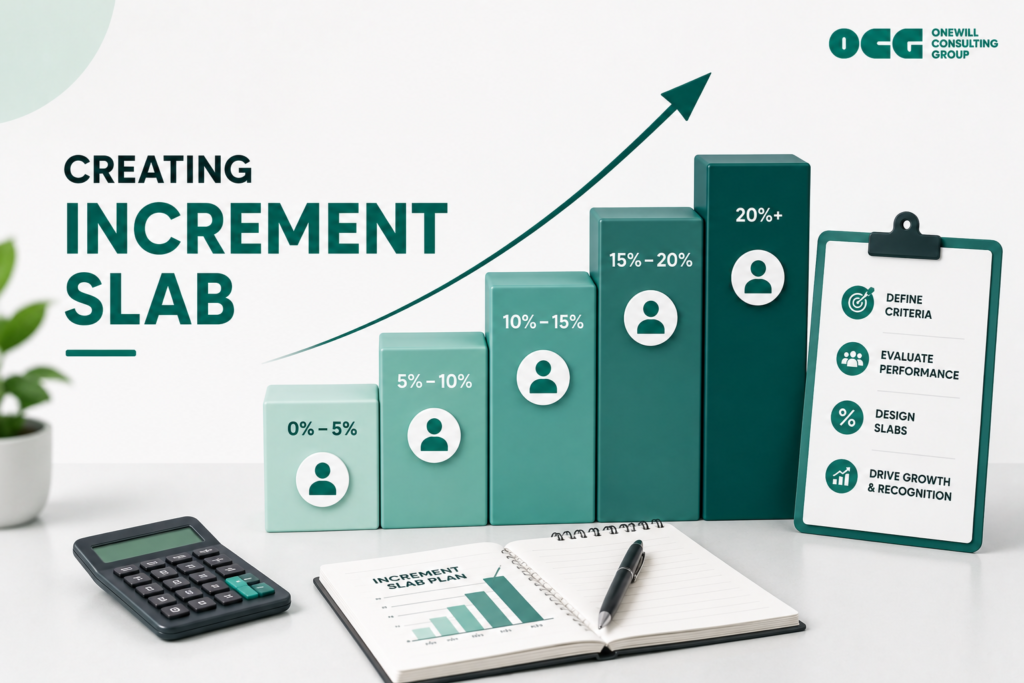
Rating 5 – Exceptional: 15–20% increment This employee has gone significantly beyond their targets. They deserve to feel it in their salary. This also sends a powerful signal to the rest of the team about what exceptional performance looks like.
Rating 4 – Above Expectations: 10–14% increment Strong performers who consistently deliver above target. Rewarding them well is critical for retention. These are your future leaders.
Rating 3 – Meets Expectations: 6–9% increment Solid, reliable contributors. A fair increment that keeps pace with inflation and market rates. This is your largest group.
Rating 2 – Below Expectations: 2–5% increment A minimal increment with a clear message – performance must improve. Pair this with a structured Performance Improvement Plan.
Rating 1 – Unsatisfactory: 0% increment No increment. A direct conversation about the future of their role in the organisation is necessary.
Adjust the percentage bands based on your industry, company profitability, and the current salary market in your city. A technology company in Bengaluru will have different bands than a manufacturing SME in Rajkot. The principle remains the same – performance drives reward.
Beyond Base Salary – Building a Complete Reward Framework
Increments are one part of a complete reward strategy. For SMEs that want to retain top talent without unlimited salary budgets, consider these additional levers.
Performance bonus. A quarterly or annual bonus tied to specific targets. This rewards results in real time rather than waiting for the annual cycle. Even a ₹10,000–25,000 bonus for hitting a quarterly target creates significant motivation.
Role upgrades. A promotion – even without a large salary jump – signals recognition. Changing a title from Executive to Senior Executive or Assistant Manager to Manager matters deeply to young professionals in India.
Responsibility expansion. Give high performers more ownership. Lead a new project. Manage a small team. This satisfies ambition and builds capability simultaneously.
Skill development investment. Paying for a certification, a course, or an industry conference is a powerful retention tool. It shows you are investing in the person’s future – not just their present output.
Common Mistakes to Avoid When Designing Increment Slabs
Mistake 1 – Making it a secret. If employees do not know the increment framework exists, it cannot motivate them. Share the slab structure openly. Tell your team at the beginning of the year exactly how increments will be determined. Transparency creates trust and drives performance.
Mistake 2 – Changing the rules mid-cycle. If you set a framework in April, honour it in March. Changing criteria after the fact destroys credibility. Your team will never trust the system again.
Mistake 3 – Letting manager bias override ratings. In Indian SMEs, it is common for a manager to give everyone in their team a Rating 4 to avoid difficult conversations. Train your managers on objective rating. Consider calibration sessions where all managers review ratings together before they are finalised.
Mistake 4 – Ignoring market benchmarks. Your increment slab must be anchored to market salary data. If the market is moving at 12% for your industry and you are giving 6%, you will lose people regardless of how structured your process is. Check salary benchmarks annually for your sector and city.
Mistake 5 – Forgetting to have the conversation. An increment letter delivered without a conversation is a missed opportunity. Sit with every employee. Tell them what they did well. Tell them what they need to improve. Connect their increment to their performance story. This conversation – done well – is more motivating than the number itself.
How to Communicate Increments Effectively
The how of increment communication is as important as the what.
Start with appreciation; Acknowledge what the person contributed over the past year. Be specific. Do not just say “you did well.” Say “you brought in three new accounts and your team attrition was zero – that matters to this business.”
Then share the increment; Connect it clearly to their performance rating. “Based on your performance this year, you have been rated a 4 – above expectations. Your increment this cycle is 12%.”
Then talk about the future; What do they need to do to reach the next level? What would a Rating 5 look like for them next year? End the conversation with forward momentum, not just backward review.
A well-conducted increment conversation takes 20–30 minutes. It leaves the employee feeling seen, valued, and motivated. This is entirely within your control as a leader.
OCG EXPERT INSIGHT: In our work with Indian SMEs, we find that the increment conversation matters as much as the increment itself. Employees who receive a smaller increment but feel genuinely heard and appreciated are more likely to stay than employees who receive a generous increment with no conversation. Recognition and clarity are not soft HR luxuries – they are retention tools that cost nothing but time and attention.
REAL EXAMPLE FROM OCG: During OneWill Consulting Group’s engagement with Solex Energy during their HR expansion phase, one of the key interventions was designing a structured increment and reward framework. Before the framework was in place, salary revisions were ad hoc and inconsistent – leading to internal inequity and quiet resentment among high performers. After implementing a transparent performance-linked increment slab, team motivation improved visibly and attrition among top performers dropped significantly within two appraisal cycles.
Conclusion – Pay for Performance, Not for Presence
A structured increment slab is not about spending more money on salaries. It is about spending your salary budget more intelligently. When your best people know that performance is recognised and rewarded – and when your average performers can see exactly what they need to do to earn more – your entire team moves forward together. Build the framework. Be transparent about it. Have the conversations. Your retention numbers will tell the story.
CALL TO ACTION
Ready to build a performance-linked reward system for your SME?
OneWill Consulting Group has helped 100+ SMEs across India design compensation and HR frameworks that retain top talent and drive growth. Book a free 30-minute consultation at onewillconsulting.com