
HR Budget Planning for SMEs – How Much Should You Spend on People
Most Indian SME owners either overspend on the wrong HR activities or underspend until a people crisis hits. Here is how to budget for people – intelligently.
Human Resources | 7 Min Read | By OneWill Consulting Group
H1: HR Budget Planning for SMEs – How Much Should You Really Spend on Your People
Most Indian SME owners treat HR spending as an afterthought. Salaries go out every month. A recruitment fee gets paid when someone leaves. A training programme gets approved once a year if there is budget left over. There is no plan. There is no framework. And when a people crisis hits – a sudden attrition wave, a compliance notice, a hiring freeze – the business pays far more than it would have if it had planned properly from the start.
What You Will Learn:
- What HR budgeting really covers beyond just salaries
- How much Indian SMEs should realistically spend on people at different growth stages
- A simple framework to build your HR budget from scratch
- Where most SMEs waste HR spend – and where they should invest more
What HR Budgeting Actually Covers
When most SME owners hear “HR budget” they think salaries. Salaries are the largest line item – but they are only one part of the picture.
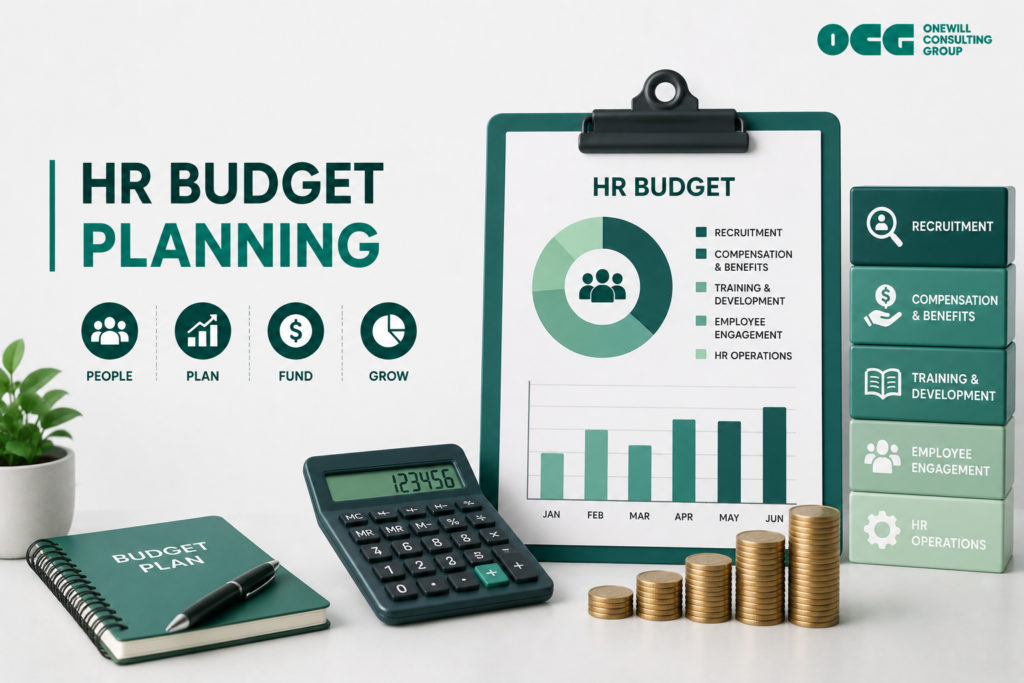
A complete HR budget covers six areas.
Compensation and benefits. Base salaries, PF contributions, ESIC, gratuity provisions, health insurance, and any performance bonuses. This is typically 70–80% of your total HR spend.
Recruitment costs. Job portal subscriptions like Naukri and LinkedIn, placement agency fees, referral bonuses, and background verification costs. For a growing SME hiring 10–15 people a year, this adds up quickly.
Training and development. Skill-building programmes, certifications, leadership development, and on-the-job training costs. This is the most commonly underfunded area in Indian SMEs.
HR technology. HRMS software, payroll tools, attendance systems, and performance management platforms. Cloud-based tools have made this affordable even for 20-person teams.
Employee engagement. Team events, recognition programmes, wellness initiatives, and culture-building activities. Not a luxury – a retention investment.
Compliance and administration. Labour law compliance costs, PF and ESIC administration, statutory audits, and any external HR consulting support.
If your HR budget only covers salaries and the occasional recruitment fee, you are operating without a plan.
How Much Should an Indian SME Spend on HR – Stage-by-Stage
There is no single right number. But there are clear benchmarks based on business size and stage.
Stage 1 – ₹1–5 Crore turnover, 5–20 employees. At this stage, HR spend beyond salaries should be approximately 3–5% of your total payroll. Focus on basic compliance, a simple attendance and payroll tool, and one or two team engagement activities per year. Do not over-invest in HR infrastructure at this stage. Keep it lean and functional.
Stage 2 – ₹5–25 Crore turnover, 20–60 employees. HR spend beyond salaries should move to 6–8% of payroll. You now need structured recruitment processes, an HRMS tool, a training budget, and a basic health insurance policy for your team. This is the stage where most SMEs underinvest – and pay for it through high attrition and poor hiring.
Stage 3 – ₹25–100 Crore turnover, 60–200 employees. HR spend beyond salaries should be 8–12% of payroll. You need a dedicated HR team, a structured performance management system, leadership development programmes, and robust compliance infrastructure. At this scale, poor HR systems become a serious business risk.
Stage 4 – Above ₹100 Crore turnover, 200+ employees. HR spend including a full HR department, CHRO or senior HR leadership, comprehensive employee benefits, and organisational development programmes should be budgeted carefully as a strategic business investment – not a cost centre.
Building Your HR Budget – A Practical Framework
Here is a simple six-step process to build your HR budget for the coming year.
Step 1 – Start with your headcount plan. How many people do you have today? How many do you plan to hire this year? What roles are at risk of attrition based on last year’s patterns? Your headcount plan is the foundation of your HR budget.
Step 2 – Calculate your total compensation cost. Add up all salaries, PF contributions at 12% of basic, ESIC at 3.25% of gross for eligible employees, gratuity provisions, and any health insurance premiums. This is your largest number. Be accurate – not approximate.
Step 3 – Estimate recruitment costs. Calculate cost per hire for your business. If you filled 12 positions last year and spent ₹4 lakh on job portals, agency fees, and referral bonuses, your average cost per hire is ₹33,000. Project next year’s hiring plan and multiply accordingly.
Step 4 – Allocate a training budget. A practical benchmark for Indian SMEs is ₹5,000–15,000 per employee per year on training and development. For a 50-person team, that is ₹2.5–7.5 lakh annually. Prioritise roles where skill gaps are directly impacting business performance.
Step 5 – Plan for HR technology. Cloud HRMS platforms suitable for Indian SMEs – such as Keka, Darwinbox, or GreytHR – range from ₹3,000–8,000 per month for a 50-person team. This is one of the highest-return HR investments an SME can make. Automated payroll, attendance tracking, and leave management save enormous admin time and reduce compliance errors.
Step 6 – Set aside a contingency buffer. Unexpected attrition, urgent replacement hires, a compliance notice, an unplanned training need – these happen. Build a 10–15% contingency buffer into your HR budget. Businesses that plan for the unexpected handle it far better than those that do not.
Where Most Indian SMEs Waste HR Spend 
Knowing where not to spend is as important as knowing where to invest.
Expensive recruitment agencies for junior roles. Paying 8–10% of CTC to a placement agency for an executive-level hire is unnecessary. Use job portals and employee referrals for roles below ₹8 lakh CTC. Reserve agency fees for specialised or senior positions.
Generic training programmes. Booking your entire team into an off-the-shelf motivational workshop feels productive. It rarely changes behaviour. Invest in specific, role-relevant skill development instead.
Over-engineered HRMS for small teams. A 15-person team does not need an enterprise-grade HR platform. A simple, affordable cloud tool does the job at a fraction of the cost.
One-time engagement events without follow-through. An annual team trip is enjoyable. But if it is the only engagement initiative all year, it changes nothing. Consistent small actions – regular recognition, feedback conversations, growth discussions – deliver far more value than one big event.
Where Most Indian SMEs Underspend – And Pay for It Later
Health insurance. Group health insurance for employees costs ₹2,500–5,000 per employee per year for basic coverage. In a post-COVID world, this is a significant retention and goodwill tool. Most SMEs still do not provide it.
Manager training. Your managers are your biggest engagement lever. Yet most Indian SMEs invest nothing in training their managers to lead people effectively. A poorly trained manager destroys engagement, drives attrition, and costs far more than a two-day leadership workshop.
Compliance infrastructure. Labour law compliance is not glamorous. But a PF default, an ESIC notice, or a sexual harassment complaint without proper documentation can cost your business lakhs in penalties and reputational damage. Invest in compliance before you are forced to.
HR consulting for people strategy. Many SME owners try to build HR systems on their own – with limited knowledge and even less time. An experienced HR consultant helping you build the right framework in 60–90 days is far cheaper than 12 months of trial and error.
OCG EXPERT INSIGHT: At OneWill Consulting Group, we consistently see that the SMEs with the strongest people systems spend no more than their peers – they simply spend more intentionally. The difference between an SME that struggles with people problems and one that scales smoothly is rarely budget size. It is budget strategy. Know what you are spending. Know why you are spending it. And measure the return.
REAL EXAMPLE FROM OCG: When OneWill Consulting Group worked with Solex Energy on their HR expansion, one of the foundational exercises was building a structured HR budget aligned to their growth plan. Before this work, HR spending was reactive – costs appeared when crises arose. After building a planned HR budget with clear allocations across recruitment, compliance, training, and engagement, Solex Energy was able to scale their team systematically without the chaotic hiring-and-attrition cycle that had previously held them back.
Conclusion – Your People Budget is a Growth Investment
HR budgeting is not about controlling costs. It is about investing in the engine of your business – your people. A well-planned HR budget reduces attrition, improves hiring quality, keeps you legally compliant, and builds the kind of team that drives sustainable growth. Stop treating HR spend as a line item to minimise. Start treating it as a strategic allocation that delivers measurable returns. Your business will grow faster for it.