
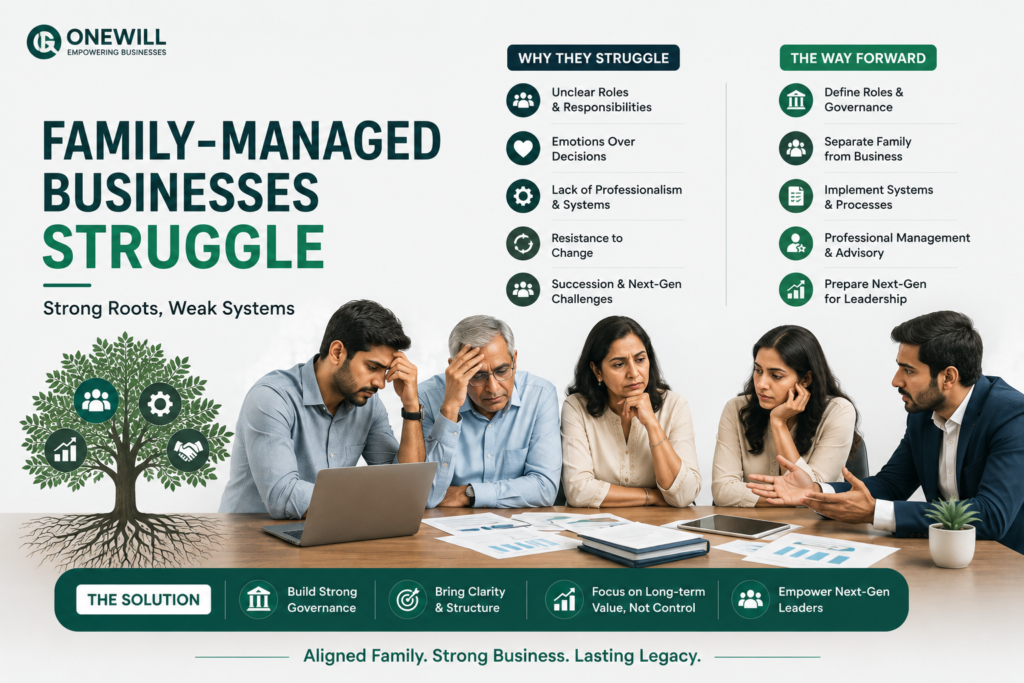
Why Family-Managed Businesses Struggle to Scale and How to Fix It
India’s family businesses are its economic backbone. But most of them hit an invisible wall well before their potential is reached. Here is why – and how to break through it.
Business Strategy | 8 Min Read | By OneWill Consulting Group
Why Family-Managed Businesses Struggle to Scale – And What to Do About It
Almost 80% of Indian businesses are family-owned or family-managed. From a small textile trader in Surat to a mid-size manufacturing group in Ludhiana, the family business is the engine of India’s private economy. And yet, most of these businesses plateau well before their real potential. Not because the market is small. Not because the founder lacks ambition. But because the dynamics inside a family business – the relationships, the loyalties, the unspoken rules – create growth barriers that are invisible until they become critical.
What You Will Learn:
-
- The six most common reasons Indian family businesses struggle to scale
-
- Why mixing family relationships with business roles creates hidden damage
-
- How to professionalise a family business without losing its values
-
- A practical roadmap to fix the most common family business problems
The Unique Strength – and the Hidden Weakness – of Family Businesses
Family businesses have genuine advantages. Trust is high. Commitment is deep. Decision-making can be fast. Long-term thinking comes naturally. The founder’s personal reputation and relationships create a powerful foundation.
But these same strengths carry hidden weaknesses.
Trust becomes a barrier to accountability. Deep commitment to family members overrides merit-based decisions. Fast decision-making by a single patriarch creates a bottleneck at scale. And personal relationships make it almost impossible to have the difficult conversations that every growing business needs.
The very things that made the family business successful in its early years become the constraints that prevent it from scaling.
Problem 1 – Roles Based on Relationships, Not Competence
In most Indian family businesses, who holds what role is determined by birth order, family loyalty, or personal relationships – not by skills or track record.
The founder’s son becomes the Sales Head at 26 with no sales experience. The brother-in-law manages finance without a financial background. A trusted long-time employee holds a senior position they have outgrown years ago.
This creates two serious problems simultaneously.
First, critical functions are led by people who are not equipped to lead them. The business suffers in performance, decision quality, and growth capacity.
Second, talented non-family employees – who can clearly see that merit does not drive advancement – lose motivation and leave. You lose your best people precisely when you need them most.
The fix is clear but uncomfortable. Roles must be defined by competency requirements. Family members must earn their positions – ideally with external work experience before joining the family business. And non-family professionals must be given genuine authority, not just titles.
Problem 2 – No Separation Between Family and Business
In a family business, the dining table and the boardroom are often the same place. Business decisions get made over family dinners. Personal disputes spill into business operations. Financial boundaries between family and company are blurred.
This lack of separation creates chronic instability.
When two brothers disagree at home, it affects how they function in the business the next morning. When a family member draws from the business account without formal process, it creates resentment and financial opacity. When family council decisions override business logic, strategy suffers.
The most resilient Indian family businesses – the Tatas, the Godrejs, the Mahindras – are successful precisely because they created clear governance structures that separated family interests from business interests.
For a growing SME, this means establishing clear boundaries. Business decisions follow a defined process. Family compensation is formal and documented. Personal disputes stay out of the office. A family council or governance structure handles family matters separately from business operations.
Problem 3 – Succession Planning Happens Too Late
Most Indian family business founders avoid succession conversations until they are forced into them – by health, age, or crisis. By then it is almost always too late for a smooth transition.
Without early succession planning, three things happen consistently. Key knowledge and relationships live only in the founder’s head, with no structured transition to the next generation. Power struggles emerge among family members when succession becomes inevitable – often splitting the business and the family simultaneously. And the business loses years of momentum while leadership uncertainty creates paralysis at every level.
Succession planning is not a single conversation. It is a multi-year process. It involves identifying and grooming the next generation early. It requires external work experience before family members take leadership roles. It needs formal documentation of governance, ownership, and operational authority.
Start this conversation ten years before you think you need to. That is not pessimism. It is the most responsible thing a family business founder can do.
Problem 4 – Resistance to Professional Management
As a family business grows beyond ₹10–15 crore, it needs professional management at the leadership level. It needs a Finance Head who understands complex cash flow. A Sales Head with market knowledge and leadership skills. An Operations Head who can build systems and manage scale.
Most family business owners recognise this intellectually. But they resist it emotionally.
Bringing in a professional outsider feels like admitting inadequacy. It feels like losing control. And in many Indian family businesses, it creates anxiety among family members who fear being displaced or overruled.
So the business stays family-managed well past the point where professional management is needed. Growth stalls. Good people leave. And the founder burns out trying to compensate personally for the gaps.
The businesses that break through this barrier understand that professional management does not replace the family. It enables the family to focus on ownership and strategy while professionals manage operations. This is not a loss of control. It is a mature exercise of it.
Problem 5 – Treating Non-Family Employees as Second Class
In many Indian family businesses, there are two clear tiers. Family members and trusted old-timers at the top. Everyone else below.
Non-family employees face higher bars for recognition, lower ceilings for advancement, and constant uncertainty about their standing. They work hard. They deliver results. But they know – and everyone knows – that the best roles are reserved for family.
This creates a talent retention crisis. High-performing professionals join the business, quickly understand the unwritten rules, and leave within 18–24 months. You end up with a leadership team of family members and long-tenured loyalists – and a constant exodus of the talent the business needs to scale.
The fix requires a genuine commitment to meritocracy. Clear performance frameworks. Transparent advancement criteria. Non-family professionals given real authority and real accountability. When talented outsiders can see a future in your business, they stay and contribute at their highest level.
Problem 6 – Emotional Decision-Making Over Business Logic
Family businesses are deeply emotional environments. And emotion – while powerful in culture-building – is dangerous in strategic decision-making.
An underperforming family member is not exited because of the relationship damage it would cause. A poor investment is doubled down on because it was the founder’s pet project. A business pivot is blocked because it feels like betraying the legacy. A conflict between two family members paralyses an entire department for months.
Every one of these situations represents a business paying a real financial cost for an emotional dynamic.
The solution is not to remove emotion from the business. It is to create governance structures that channel emotion appropriately and protect business decisions from being distorted by it. An independent board member. A structured decision-making process. Clear criteria for when business logic must override personal preference.
A Practical Roadmap to Professionalise Your Family Business 
You do not need to transform overnight. Here is a phased, practical approach.
Phase 1 – Create
governance clarity. Document
who owns what. Define decision-making authority. Separate family finances from
business finances formally. Establish a family governance structure – even a
simple one.
Phase 2 – Define
roles by competency. Audit
every leadership role in the business. Define what competencies that role
requires. Assess whether current holders – family or otherwise – meet those
requirements. Fill gaps with professional hires where needed.
Phase 3 – Build
professional management systems.
Implement formal HR policies, performance management, financial reporting, and
operational processes. The business must run on systems, not on personalities.
Phase 4 – Start
succession conversations early.
Identify the next generation of leadership. Give them external experience.
Create a formal transition plan. Document it. Review it annually.
Phase 5 – Bring in
independent perspective. An
independent board member, an advisory board, or an external business consultant
brings objectivity that is impossible to maintain internally in a family
business. This outside perspective is one of the most valuable investments a
scaling family business can make.
OCG EXPERT INSIGHT: At OneWill Consulting Group, we have worked closely with several family-managed Indian SMEs navigating these exact challenges. The turning point in every successful case was the same – the founding family member made a conscious decision to separate their identity from the business identity. That one shift – from “this business is me” to “this business must be bigger than me” – unlocked everything else. Governance, professional management, and succession planning all followed from that foundational decision.
REAL EXAMPLE FROM OCG: When OneWill Consulting Group began working with Platina Stones and Ceramics, many of the classic family business constraints were present – informal role definitions, founder-dependent decision-making, and limited professional management infrastructure. OCG worked systematically to build governance clarity, introduce professional systems, and reorient the leadership structure around competency rather than relationship. The business transformation that followed – including 140% business growth – was built on this foundation of professionalisation. A family business can absolutely scale. But only when it builds the structure that scale demands.
Conclusion – Family Values, Professional Systems
The goal of professionalising a family business is not to remove the family from the business. It is to protect the family’s legacy by building a business strong enough to outlast any one generation. The values, the commitment, the long-term thinking that family businesses bring – these are genuine competitive advantages. But they must be housed in professional systems, clear governance, and merit-based leadership to realise their full potential. Your family built this business. Now build a business worthy of your family’s legacy.