
Stop running appraisals on gut feel. Here is how Indian SME owners can build a performance management system that actually drives results.
Human Resources | 7 min read | By OneWill Consulting Group
Your Team Is Working Hard – But Is It Working on the Right Things?
Most Indian SME owners have no formal performance management system. Appraisals happen once a year, usually based on impressions and memory. Increments are decided in a cabin with a gut feel and a salary comparison. Good employees feel unrecognised. Poor performers stay too long. And the business suffers in silence. A proper performance management system fixes all of that – and it does not require an HR department to implement one.
What You Will Learn:
- What a performance management system is and why your SME needs one now
- The difference between KRAs, KPIs, and appraisals – and how they work together
- How to build and implement a PMS from scratch in your business
- The most common mistakes Indian SMEs make with performance management
What Is a Performance Management System?
A Performance Management System – or PMS – is a structured process for setting expectations, tracking progress, giving feedback, and evaluating employee performance consistently.
It is not just an appraisal form. It is an ongoing cycle. It starts with goal setting. It continues with regular check-ins. It ends with a fair, data-driven review.
Think of it this way. A sales manager cannot be told “improve your performance” without knowing what metric is being measured. A PMS removes that ambiguity. Every employee knows what is expected, how they will be measured, and what success looks like before the review period begins.
For Indian SMEs growing beyond 15 to 20 employees, a PMS is the tool that separates a well-managed business from an operationally chaotic one.
KRAs and KPIs – The Foundation of Any PMS
These two terms are the backbone of your performance management system. They are related but not interchangeable.
KRA – Key Result Area defines what an employee is responsible for. It is the territory of their role. For a sales executive, a KRA might be “revenue generation” or “client acquisition.” It tells you where they must focus their energy.
KPI – Key Performance Indicator defines how you measure success within that KRA. For the same sales executive, the KPI might be “close ₹15 lakh in new business per month” or “onboard 5 new clients per quarter.” It gives the KRA a number and a deadline.
Here is why both are essential. Without KRAs, your team has no focus. Without KPIs, your reviews are based on opinion – not evidence. Together, they make performance conversations fair, objective, and productive.
In Indian SMEs, the ideal structure is four to six KRAs per role, each with two to three measurable KPIs attached. That is enough focus without overwhelming your team.
The Performance Management Cycle – How It Works in Practice
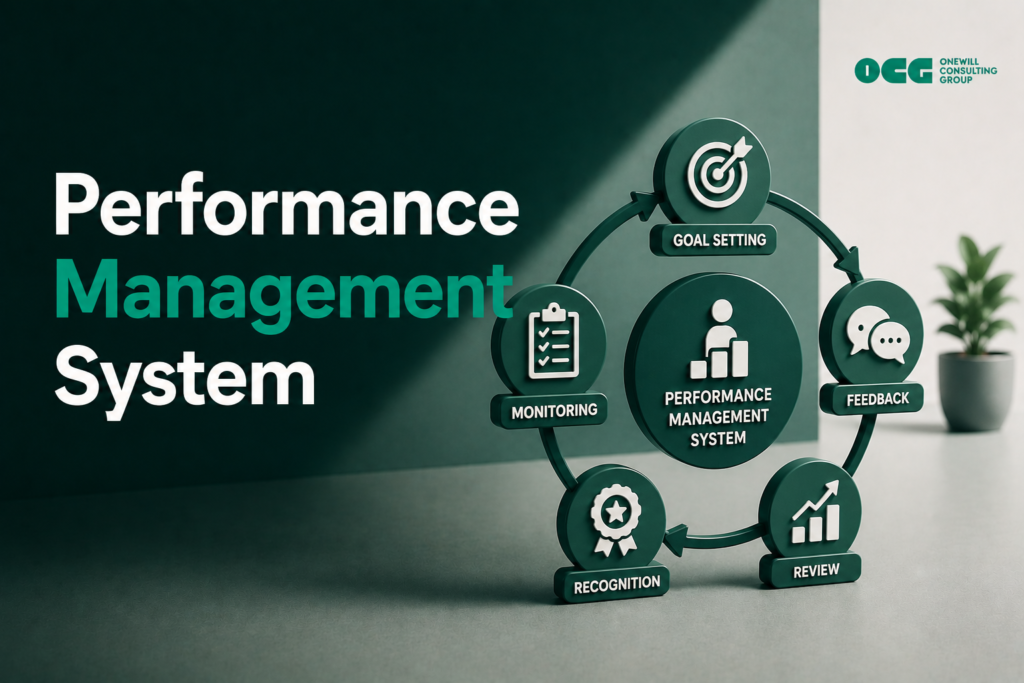
A PMS is not a one-time event. It is a continuous cycle with four stages.
Stage one: Goal Setting. At the start of each quarter or half-year, every employee and their manager jointly define KRAs and KPIs. The goals must align with the company’s broader business targets. An employee in Pune or Chennai should understand exactly how their work connects to the company’s overall growth plan.
Stage two: Ongoing Check-ins. Monthly or bi-monthly one-on-one meetings between manager and employee. Track progress against KPIs. Identify blockers early. Provide real-time feedback. Do not wait for the annual review to tell someone they are off track.
Stage three: Mid-Year Review. A formal halfway review to assess progress, adjust goals if business conditions have changed, and address development needs. This is also a good time to recognise employees who are exceeding expectations.
Stage four: Annual Appraisal. The final performance review based on KPI achievement across the year. This is where increment decisions, promotions, and development plans are discussed – backed by evidence, not opinions.
Companies that replaced annual-only appraisals with this continuous review approach have seen measurable improvements in both productivity and employee retention.
How to Build a PMS for Your SME – Step by Step
You do not need expensive software or an HR consultant to start. Here is a practical approach for a growing Indian SME.
Step one: Define roles clearly. Before you can set KRAs, every role in your business needs a clear job description. If a person’s responsibilities are vague, their performance goals will be vague too.
Step two: Set KRAs for each role. Identify four to six core responsibility areas per role. Align these with your business priorities. If your company is focused on revenue growth, your sales team’s KRAs must reflect that directly.
Step three: Build SMART KPIs for each KRA. Every KPI must be Specific, Measurable, Achievable, Relevant, and Time-bound. “Improve customer service” is not a KPI. “Achieve a customer satisfaction score of 85% by June 30” is.
Step four: Document everything in writing. Both manager and employee must sign off on the agreed KRAs and KPIs. No verbal agreements. Written documentation prevents disputes and creates accountability.
Step five: Schedule monthly check-ins. Put them on the calendar from day one. These 30-minute conversations are where your PMS lives or dies.
Step six: Run mid-year and annual reviews. Use the KPI data you have been collecting. Make increment and promotion decisions based on measurable evidence.
Step seven: Link performance to rewards. Define upfront how KPI achievement connects to variable pay and increments. Transparency here is what builds trust in the system.
Linking Performance to Increments and Rewards
A PMS without a clear link to rewards is just paperwork. Your team will not take it seriously.
Define a simple structure. For example: employees who achieve 90% or more of their KPIs qualify for a full increment and are considered for promotion. Those between 70% and 90% receive a partial increment with a development plan. Those below 70% are placed on a structured improvement programme.
This kind of clarity removes favouritism from increment decisions. It builds trust across your organisation. Employees in Surat or Hyderabad know they will be evaluated the same way as employees in your head office.
It also gives you data to make difficult decisions faster. When a non-performer needs to be managed out, you have documented evidence. When a high performer deserves recognition, you have the numbers to justify it.
Common PMS Mistakes Indian SMEs Must Avoid
These mistakes are widespread in Indian businesses – and expensive.
Mistake one: Only doing annual reviews. Once a year is too late to correct problems and too infrequent to motivate behaviour change. Move to quarterly or monthly check-ins.
Mistake two: Setting goals the employee had no input in. When managers impose KPIs without discussion, employees feel no ownership. Involve your team in setting their own goals. Employees involved in goal setting are significantly more engaged and committed.
Mistake three: Measuring activity instead of outcomes. “Attended all meetings” is an activity. “Closed ₹20 lakh in new business” is an outcome. Your PMS must measure results, not effort.
Mistake four: Making it a one-way conversation. Performance reviews in Indian SMEs often feel like top-down judgements. Build in time for employees to self-assess and raise concerns. Two-way conversations produce better results.
Mistake five: Ignoring poor performers. A PMS only works if you act on the data. Identifying a poor performer and doing nothing sends the wrong signal to your entire team.
OCG EXPERT INSIGHT:
At OneWill Consulting Group, we find that most Indian SMEs already know who their top performers are – they just cannot prove it with data. The single biggest shift a PMS creates is moving from “I feel like you did well” to “your numbers show you achieved 112% of your KPI target.” That shift changes how your team thinks, behaves, and grows. Start simple. Even a basic KRA-KPI sheet with monthly check-ins is dramatically better than annual reviews based on memory.
REAL EXAMPLE FROM OCG:
When OneWill Consulting Group implemented the 3D-EPMS – a structured employee performance management system – for Upraise Finserve, the organisation had no formal way to measure individual contribution. OCG designed role-specific KRAs and KPIs, linked them to the increment structure, and created a quarterly review cadence. The result was measurable clarity at every level of the organisation. Managers became more confident in their decisions. Employees became more focused on outcomes. And the business gained the data infrastructure needed to reward performance fairly and scale its team sustainably.
Conclusion
A performance management system is not an HR formality. It is a business tool. When your team knows what is expected, how they will be measured, and how their performance connects to rewards – they perform differently. They perform better. For Indian SMEs navigating growth, this structured clarity is what separates high-performing businesses from ones that plateau. Build your PMS before you need it, not after the problem arrives.
CALL TO ACTION
Ready to build a performance management system that is fair, measurable, and built for your business?
OneWill Consulting Group has helped 100+ SMEs across India create structured performance frameworks that drive real results. Book a free 30-minute consultation at onewillconsulting.com