
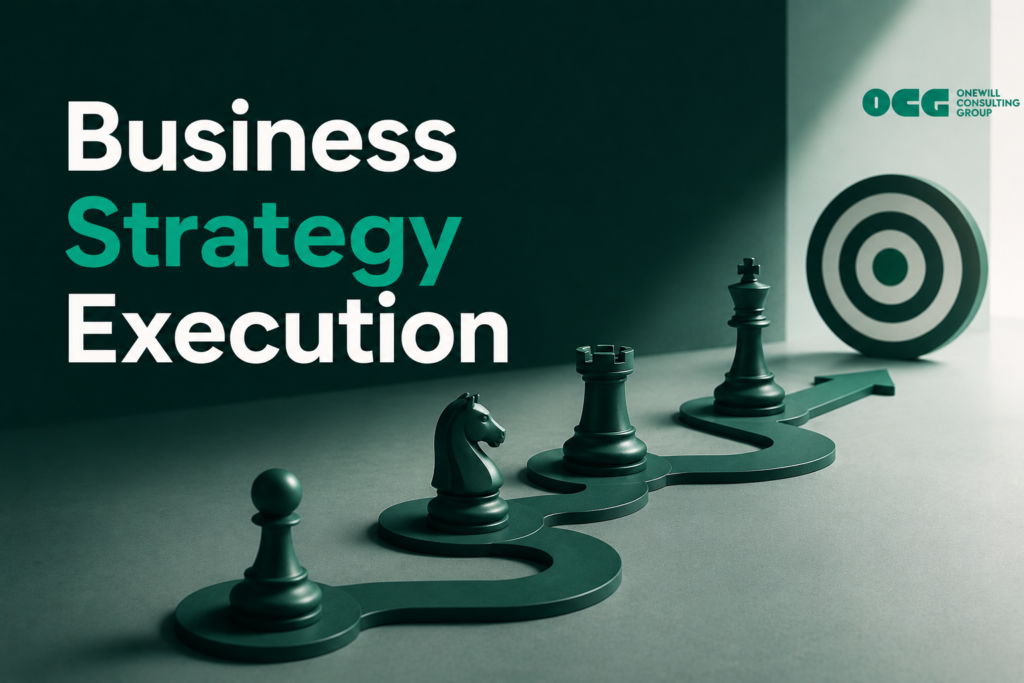
Most Indian SMEs have a strategy. Very few actually execute it. The gap between planning and doing is where growth goes to die. Here is how to close it.
Business Strategy | 8 Min Read | By OneWill Consulting Group
Business Strategy Execution – What It Means and Why Most Indian SMEs Get It Wrong
Every year, thousands of Indian SME owners sit down and plan. They set revenue targets. They identify new markets. They decide to improve their operations, hire better people, and build stronger systems. The plans are ambitious. The intentions are genuine. And then the year happens. Daily fires take over. Urgent always beats important. The plan sits in a folder – or a WhatsApp note – and the business continues exactly as before. This is not a strategy problem. It is an execution problem. And it costs you more than you realise.
What You Will Learn:
-
- What strategy execution actually means – and why it is different from strategy planning
-
- Why 90% of businesses fail to execute their strategies effectively
-
- The six most common strategy execution failures in Indian SMEs
-
- A practical framework to turn your business strategy into daily action
What is Strategy Execution – And Why it is Not the Same as Strategy Planning
Strategy planning is deciding where you want to go. Strategy execution is actually getting there.
Most businesses are reasonably good at planning. They can articulate a vision. They can identify growth opportunities. They can set revenue targets and list the things they want to change. Planning is intellectually satisfying. It feels like progress. It generates energy and optimism.
Execution is different. Execution is uncomfortable. It involves confronting resource constraints, having difficult conversations, holding people accountable, and maintaining focus when a hundred urgent things compete for your attention every day.
Research shows that between 60 and 90% of business strategies fail at the execution stage – not because they were bad strategies, but because the gap between planning and implementation was never properly bridged.
For Indian SMEs specifically, this gap is even wider. Why? Because most SMEs have no formal execution system. The strategy exists in the founder’s head, or at best in a presentation from last year’s planning meeting. There is no mechanism to translate it into daily priorities, departmental targets, or individual accountability. The strategy dies quietly, slowly, between planning sessions.
The Strategy Execution Gap – What It Looks Like in Practice
You will recognise the strategy execution gap if any of these sound familiar.
-
- You had a plan to expand into a new city this year. Six months in, you are still at the planning stage – waiting for the right time that never quite arrives.
-
- You decided to improve your collections process to reduce outstanding receivables. Three months later, the same clients are still paying 90 days late and nothing has structurally changed.
-
- You committed to building a stronger management team. You have had the intention for two years. You are still making every significant decision yourself.
-
- You planned to implement a CRM system to improve sales tracking. The evaluation process has been ongoing for four months. The sales team still tracks leads in a personal Excel sheet.
Why Indian SMEs Fail at Strategy Execution – The Six Root Causes 
Root Cause 1 – Strategy lives in the founder’s head, not in the organisation.
In most Indian SMEs, strategic clarity exists only at the top. The founder knows the direction. But the department heads, the team leads, and the frontline employees do not. They are executing daily tasks with no understanding of how those tasks connect to the larger business goal.
When strategy is not communicated clearly and consistently, execution is impossible. People cannot execute a strategy they do not know exists.
Root Cause 2 – No translation from strategy to action.
A strategy says, “grow revenue by 40% this year.” That is a direction. But it is not an execution plan.
An execution plan breaks that 40% growth target into specific departmental targets. The sales team needs X new clients. The operations team needs to reduce delivery time to support increased volume. The HR team needs to hire three new sales executives by March.
Without this translation – from big goal to specific actions, owners, and deadlines – the strategy remains abstract. Abstract strategies do not get executed.
Root Cause 3 – Daily operations consume all available attention.
This is perhaps the most universal execution failure. The strategy says to focus on three priorities this year. But every day brings new urgent problems – a client complaint, a delivery delay, a cash flow concern, a staff issue. Urgent always wins over important. The strategic priorities get deferred. Week after week. Month after month.
Without a structured system to protect strategic time and attention, operations will always consume strategy.
Root Cause 4 – No accountability for strategic outcomes.
Who in your business is personally accountable for executing each element of the strategy? Not responsible in a vague, general sense – but specifically accountable, with a defined outcome, a deadline, and a review cadence?
In most Indian SMEs, the honest answer is no one. Or everyone – which means the same as no one. Without clear ownership, strategic initiatives drift. They are discussed in meetings. They appear on lists. But they belong to no one, and therefore they happen for no one.
Root Cause 5 – No review rhythm for strategic progress.
Strategy is set once a year and reviewed – if at all – once a year. This is a recipe for drift. Markets change. Priorities shift. New information emerges. Without regular reviews – at minimum quarterly, ideally monthly for key metrics – the strategy quickly becomes irrelevant to the current reality of the business.
Research from McKinsey shows that organisations with disciplined review systems are more than four times more likely to execute their strategies successfully than those relying on annual planning alone.
Root Cause 6 – Confusing activity with progress.
This is the most subtle execution failure. The team is busy. Everyone is working hard. Meetings are happening. Reports are being produced. But strategic outcomes are not moving.
Busy is not the same as effective. Activity is not the same as progress. Without clear outcome metrics tied to strategic priorities, it is entirely possible to run a full year of intense activity and achieve almost none of your strategic goals.
A Practical Strategy Execution Framework for Indian SMEs
You do not need a complex system. You need a simple, consistent one. Here is a five-component framework that works for any Indian SME.
Component 1 – Strategic Clarity Document. Write your strategy in one page. Not a 40-slide presentation. One page. It should answer: Where are we today? Where do we want to be in three years? What are the three to five strategic priorities for this year? This document must be shared with and understood by your entire leadership team.
Component 2 – Quarterly Execution Plans. Break each annual strategic priority into 90-day execution goals. What specifically needs to happen in the next quarter to make progress on this priority? Assign a clear owner, specific outcomes, and a deadline. Ninety-day cycles create urgency without the overwhelm of trying to execute everything at once.
Component 3 – Departmental KPIs Linked to Strategy. Each department’s KPIs must connect directly to the strategic priorities. If your strategy includes improving customer retention, the operations team’s KPIs should include delivery time and quality metrics. The sales team’s KPIs should include renewal rates. Every department should be able to answer: how does my work contribute to our strategic priorities this year?
Component 4 – Weekly and Monthly Review Cadence. Hold a weekly leadership check-in – 30 to 45 minutes. Review progress on strategic priorities. Identify blockers. Make decisions. Do not allow this meeting to become a status report. It must be a decision-making meeting focused on strategic execution.
Hold a monthly strategic review – 90 minutes. Review KPI performance against quarterly targets. Assess whether you are on track. Adjust plans if circumstances have changed.
Component 5 – A Single Owner for Each Strategic Priority. Every strategic priority must have one named person who is accountable for its execution. Not a team. Not a committee. One person. They report progress in the weekly review. They escalate blockers. They drive the work forward.
This simple five-component system – consistently followed – will put your business in the top 10% of Indian SMEs for strategy execution quality.
What Good Strategy Execution Looks Like Day-to-Day
In a business with strong strategy execution, these things happen consistently.
Every department head starts their week knowing their three strategic priorities for the quarter and the specific actions they must take this week to advance them.
The Monday leadership meeting reviews strategic progress – not just operational updates. Blockers are surfaced and resolved in real time.
Every hiring decision, investment decision, and resource allocation decision is tested against the strategic priorities. Does this advance our strategy? Yes – proceed. No – defer or decline.
Quarterly, the leadership team steps back from operations to review strategic progress, celebrate wins, learn from shortfalls, and set the next 90-day execution plan.
The founder’s role shifts from chief firefighter to chief strategy officer – ensuring that strategic execution stays on track while the management team handles operations.
OCG EXPERT INSIGHT: At OneWill Consulting Group, we find that most Indian SME owners are excellent strategists. They understand their market, their customers, and the levers of their business deeply. What they typically lack is not strategic insight – it is execution discipline. The mindset shift required is recognising that a brilliant strategy executed at 60% effectiveness beats a mediocre strategy executed at 100% effectiveness, every time. Build your execution system first. Then refine your strategy.
REAL EXAMPLE FROM OCG: When OneWill Consulting Group began working with Platina Stones and Ceramics, there was no shortage of strategic ambition. The founders had clear ideas about where the business needed to go. What was missing was a structured execution framework – clear priorities, departmental accountability, review rhythms, and KPIs linked to strategic outcomes. OCG implemented a comprehensive strategy execution system across the organisation. With execution discipline in place, the business was able to convert its strategic ambitions into operational reality – contributing directly to the 140% business growth outcome that followed.
Conclusion – Strategy Without Execution is Fiction
A strategy that lives in a document or a founder’s mind is not a strategy. It is a wish. The businesses that grow – consistently, sustainably, and at scale – are the ones that build the systems to execute their strategies every single day. Not perfectly. Not without setbacks. But consistently, with accountability and discipline. Build your execution system. Assign ownership. Review progress regularly. Close the gap between where you are and where you want to be – one quarter at a time.