
Map your operations before chaos maps itself into your business. Here’s how Indian SMEs use flowcharts to document, standardise , and scale.
Business Consulting | 7 min read | By OneWill Consulting Group
Your Business Is Running on Memory – And That Is a Problem
If your best employee resigned tomorrow, how many processes would leave with them? Most Indian SME owners cannot answer that question confidently. Your business is likely running on verbal instructions, WhatsApp messages, and tribal knowledge locked inside a few people’s heads. That works at ₹2 crore. It breaks at ₹10 crore. Business process flowcharts are your first step out of that trap.
What You Will Learn:
- What a business process flowchart actually is and why it matters
- Which processes your SME must document first
- How to create flowcharts without expensive tools or technical expertise
- How documented operations directly accelerate business growth
What Is a Business Process Flowchart?
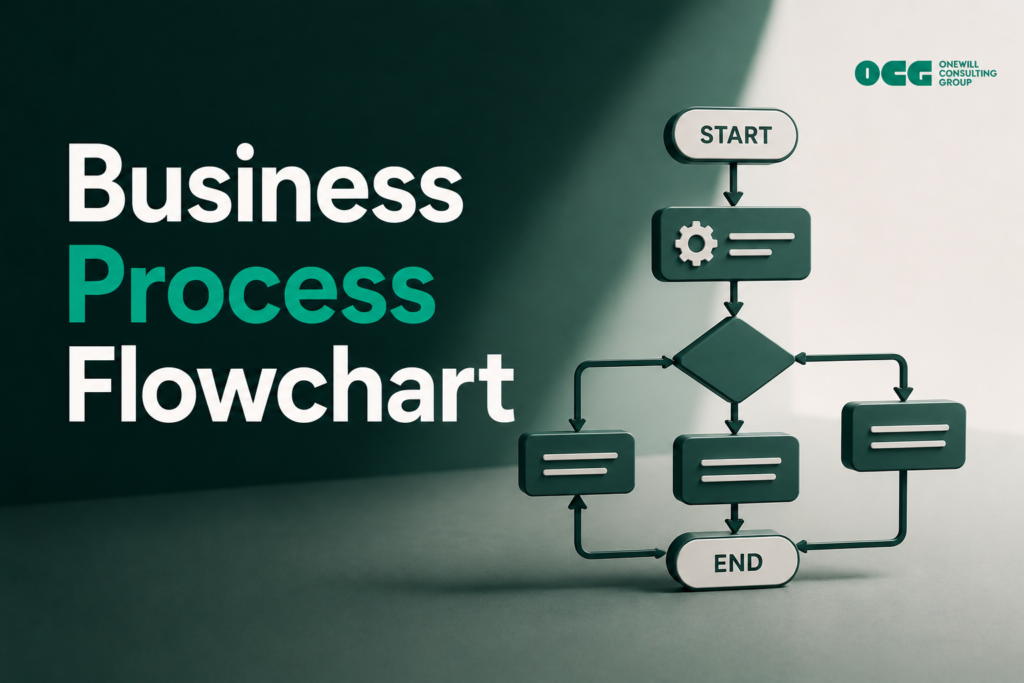
A business process flowchart is a visual diagram. It maps every step, decision point, and handoff in a specific workflow.
Think of it as a route map for how work gets done. Instead of relying on memory or verbal instructions, the flowchart shows your team exactly what to do, in what order, and who is responsible.
A basic flowchart uses simple shapes. Rectangles show tasks. Diamonds show decision points. Arrows show sequence. You do not need a designer or expensive software to create one.
For an Indian SME operating across multiple cities or managing a team of 20 to 100 people, this visual clarity is not optional. It is essential.
Why Most Indian SMEs Operate Without Documented Processes
Walk into most SMEs in Ahmedabad, Pune, or Coimbatore. You will find the same pattern.
The founder knows every process. A few senior employees know parts of it. Everyone else figures it out by watching and asking. Mistakes are common. Onboarding takes weeks. Every time a key person leaves, there is a crisis.
This is not a people problem. It is a systems problem.
Undocumented processes create dependency on individuals. They make training inconsistent. They make quality unpredictable. And they make scaling nearly impossible.
When your business grows, the cost of undocumented processes grows faster than your revenue. Every new hire, every new city, every new product line amplifies the chaos. Flowcharts break that cycle.
Which Processes Should You Document First?
You cannot flowchart everything at once. Start with these four categories.
First, revenue-critical processes. Sales order management, customer onboarding, billing, and collections. If these break, money stops flowing.
Second, high-error processes. Where do your teams make the most mistakes? Where do customer complaints come from? Start there.
Third, people-dependent processes. If one person handles a process alone and they resign, what happens? Document those immediately.
Fourth, onboarding and training processes. A new hire in Mumbai should perform exactly like a new hire in Surat. Flowcharts make that possible.
Prioritise ruthlessly. Document three to five core processes first. Then build from there.
How to Create a Business Process Flowchart – Step by Step
You do not need Visio or any paid software. Google Drawings, Lucidchart’s free version, or even pen and paper work perfectly for an SME.
Step one: Choose one process. Just one. Keep your scope tight.
Step two: Interview the people who actually do the work. Not just managers. The floor-level team knows where the real steps and exceptions are.
Step three: List every step from trigger to completion. What starts the process? What ends it? What decisions happen in between?
Step four: Identify who is responsible for each step. Name the role, not just the person. Roles outlast individuals.
Step five: Draw the flow using basic shapes. Sequence the steps with arrows. Mark decision points clearly.
Step six: Test it. Give it to a team member who was not involved. Can they follow it without asking questions? If not, simplify.
Step seven: Store it somewhere accessible. A shared Google Drive folder or your company intranet works well.
Review and update every six months or whenever the process changes.
Business Process Flowcharts vs SOPs – What Is the Difference?
| Dimension | Flowchart | SOP |
| Full Form | Flowchart | Standard Operating Procedure |
| What it is | Visual map of how a process flows | Detailed written guide for executing each step |
| Shows | Big picture — who does what, where decisions branch | How each step is done, what tools to use, what quality looks like |
| Format | Diagram / visual | Written document (step-by-step) |
| Level of Detail | Low — overview only | High — covers execution, tools, and standards |
| Best used for | Understanding process flowat a glance | Complex steps that need detailed explanation |
| Speed to create | Fast | Slow — requires more thought and documentation |
| Team adoption | High — easy to understand and follow | Moderate — requires training and discipline |
| Use together? | Yes — use as the overview | Yes — use for steps that need depth |
| Right first step for SMEs? | ✓ Yes — start here | Later — once flowcharts are in place |
How Process Documentation Directly Drives Business Growth
Here is where it gets tangible for your business.
When your processes are documented, training time drops significantly. A new hire in your Delhi branch follows the same steps as your experienced team in Chennai.
When handoffs are clear in a flowchart, errors and rework reduce. Less rework means lower operating costs. Lower operating costs mean better margins.
When you are not the only person who knows how something works, you free up your own time. That is time you can invest in strategy, new clients, and growth.
Investors and bank lenders also value documented operations. It signals that your business can run without being dependent on one person – including you, the founder.
Process documentation is not bureaucracy. It is the infrastructure that makes growth possible.
The Most Common Mistakes SMEs Make When Documenting Processes
Knowing the pitfalls saves you time and frustration.
Mistake one: Documenting how the process should work, not how it actually works. Get input from your actual team. The real process is often different from what management believes it to be.
Mistake two: Creating flowcharts and storing them in a folder no one opens. Process documentation must be part of daily operations. It should live where work happens.
Mistake three: Making flowcharts too complex. If it takes ten minutes to understand your chart, it will be ignored. Keep it simple. One process, one page.
Mistake four: Never updating the flowcharts. As your business evolves, your flowcharts must evolve with it. Outdated documentation is often more dangerous than no documentation.
Mistake five: Leaving it to one person. Process documentation is a team activity. The people who do the work should co-create the charts.
OCG EXPERT INSIGHT:
At OneWill Consulting Group, we have seen businesses with 80+ employees still running on the founder’s memory. The fastest way to fix this is to spend one focused week documenting your top five processes. That one week saves you years of operational confusion. Start with the process that causes the most customer complaints – that is always the highest priority.
REAL EXAMPLE FROM OCG:
When OneWill Consulting Group began working with Jindal’s operations team, there was significant dependence on key individuals for process execution. OCG mapped and documented the core operational workflows, which became the foundation for 100% automation of critical processes. Removing individual dependency and creating standardised process flowcharts was what made automation possible. The flowcharts did not just improve operations – they enabled a complete business transformation.
Conclusion
Your business cannot grow beyond your documented systems. Business process flowcharts are the simplest, most practical tool to convert operational chaos into structured, scalable workflows. Start with your most critical or most error-prone process. Get your team involved. Keep the diagrams simple and accessible. An Indian SME that documents its operations does not just run better today – it is built to grow tomorrow.
CALL TO ACTION
Ready to document your operations and build a business that runs without depending on any single person?
OneWill Consulting Group has helped 100+ SMEs across India create structured, scalable operational systems. Book a free 30-minute consultation at onewillconsulting.com